

That Child Who Reads at 2 But Can't Answer "How Are You?" -
Here's What's Really Going On.
Suppose a three-year-old sits in the corner of a nursery classroom, quietly reading every word on every poster, label, and book in the room. Her teacher is impressed. Her parents are proud.
But when someone asks her what she wants for lunch, she stares blankly, then repeats the question back word for word.
This isn't precocious, gifted behavior.
This is Hyperlexia, and it's one of the most misunderstood profiles in early childhood education today.
So, let’s break it down and understand What Hyperlexia actually is and how you can support children with Hyperlexia.
What Is Hyperlexia? (And Why It's Often Missed)
Hyperlexia is a condition where a child demonstrates an advanced, self-taught ability to decode written words, often well before age five, while simultaneously showing significant difficulties with language comprehension, communication, and social interaction.
It was first formally described by researchers Silberberg and Silberberg in 1967, but even today, many classroom teachers and parents mistake it for early giftedness. The reading looks impressive. The gap underneath it doesn't.
There are three recognised types:
Hyperlexia Type 1: Advanced reading in neurotypical children who simply catch on early. This typically resolves as language catches up.
Hyperlexia Type 2: Associated with autism spectrum disorder (ASD). The child reads compulsively, struggles with comprehension and social language, and may use reading as a self-regulatory tool.
Hyperlexia Type 3: Similar to Type 2 in early childhood, but language and social skills improve significantly over time. Often described as "autistic-like" tendencies that fade.
Understanding which type a child presents with matters enormously, both for intervention and for how teachers approach instruction.
Early Signs of Hyperlexia: What to Look For in the Classroom and at Home
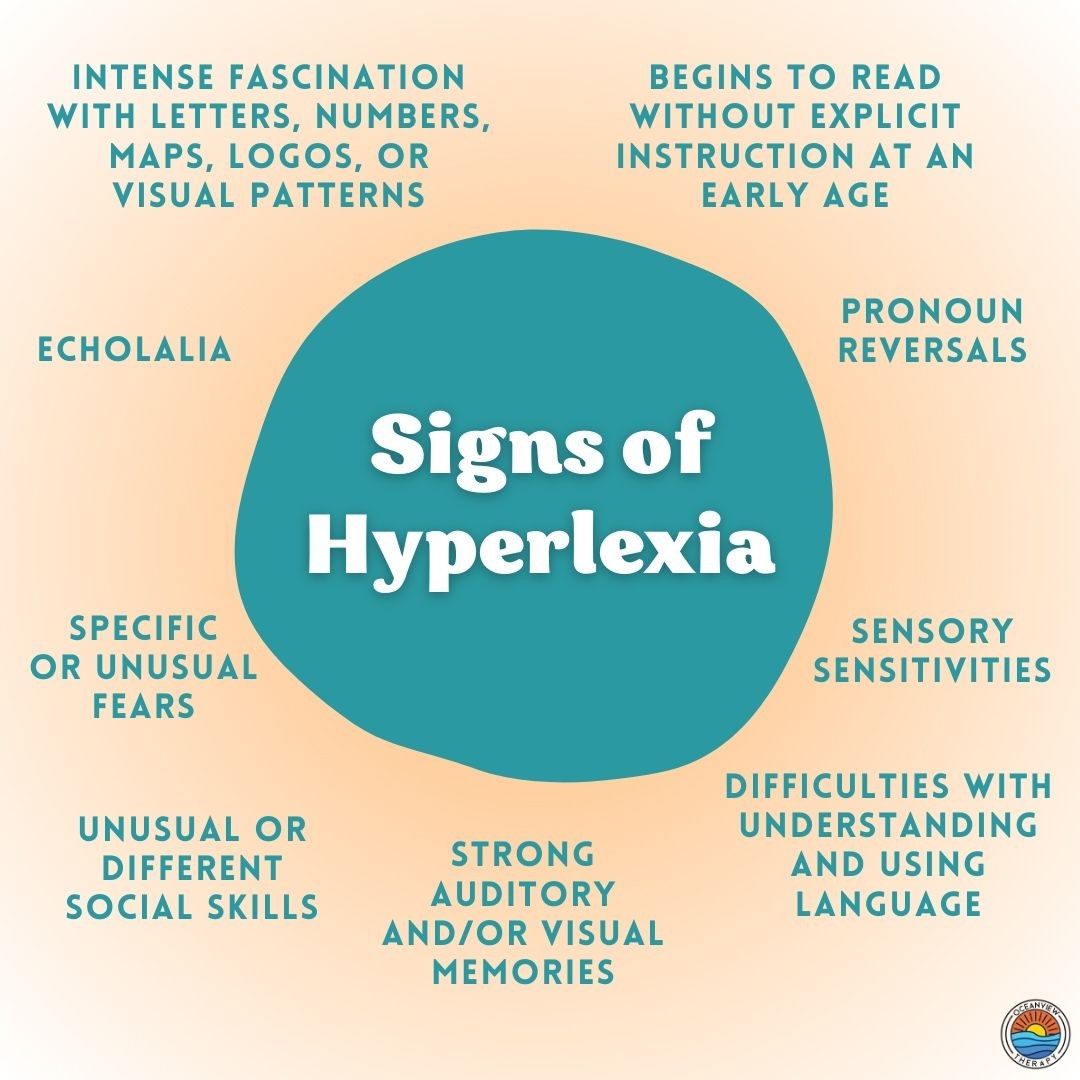
Identifying hyperlexia early can make a transformative difference. Here are the signs that should prompt closer attention:
Reading-related signs:
Language and communication signs:
Behavioural signs:
Many SEN teachers report noticing this cluster of signs but not having a name for it, which can delay appropriate referral and support by months or even years.
How Hyperlexia Differs From Giftedness (A Crucial Distinction)
This is where schools most commonly go wrong. A child who reads early is celebrated. Resources aren't allocated. The language comprehension gap is attributed to shyness, immaturity, or a slow start.
The key distinction is comprehension vs. decoding.
A gifted early reader understands what they read. They can retell stories, answer questions, and make inferences. A child with hyperlexia can decode text with remarkable accuracy but often has very little understanding of its meaning.
They read at the text rather than into it.
Another red flag: gifted readers typically use language expressively and flexibly. Children with hyperlexia often rely heavily on memorised scripts. They may quote entire scenes from a cartoon perfectly, but struggle to describe how they're feeling right now.
This distinction isn't about labelling or limiting children. It's about ensuring the right kind of teaching reaches them.
Classroom Strategies for Teaching Children With Hyperlexia
This is where the practical difference is made, in the classroom, every single day.
1. Use Their Strength as an Entry Point, Not a Party Trick
Children with hyperlexia have a genuine strength: print. Use it. Pair verbal instructions with written cards. Create visual schedules with words alongside pictures. Use written social stories to explain routines, transitions, and expectations.
Their reading ability is real and valuable. The goal is to build a bridge from decoding to meaning, not to ignore the bridge that's already there.
2. Prioritise Language Comprehension Explicitly
Reading fluency should never be assumed to equal understanding. After any reading activity, check comprehension through:
Comprehension needs to be taught, not assumed.
3. Structured Routines Reduce Anxiety and Increase Participation
Children with hyperlexia (particularly Type 2) often experience significant anxiety in unpredictable environments. A structured, predictable classroom reduces this anxiety and frees up cognitive bandwidth for learning.
Post the daily schedule visually. Give advance notice of transitions. Use a consistent set of phrases when giving instructions — novel language can be genuinely confusing.
4. Social Language Needs Direct Instruction
Conversations aren't intuitive for these children. Teach turn-taking explicitly. Use scripts as stepping stones, provide language frameworks for common social situations ("When someone says 'how are you?', you can say…"), then gradually help children move beyond the script.
Social stories (developed by Carol Gray) are particularly effective here. Written in first person and grounded in real classroom scenarios, they give children with hyperlexia a text-based map for situations that feel overwhelming.
5. Collaborate With Speech and Language Therapists
Classroom strategies work best when they align with what a speech and language therapist (SALT) is doing in intervention sessions. If the school has access to SALT support, request a joined-up approach. If not, ask for guidance on language activities to embed in daily classroom routines.
What Parents and Caregivers Can Do at Home
The strategies that work in school carry even more weight at home, where children spend the majority of their time.
- Read together, but differently
Don't just let your child read to you. Pause and ask simple questions. "What do you think will happen next?" Use the text as a conversation starter, not just a performance.
- Narrate daily life in writing
Some children with hyperlexia understand their day better when it's written down. A simple morning board, "First breakfast. Then school. Then home,", can reduce anxiety and help language stick.
- Watch for scripting and use it wisely
If your child scripts from a TV show or book, don't shut it down. Scripting often serves a communicative purpose. Gently expand it — "Yes, Bluey said that! What was she feeling?" — to build comprehension around the language they already have.
- Advocate clearly at school
Many parents have sat in meetings where a teacher says, "But they read so well." Bring examples of comprehension difficulties. Request an educational psychology assessment if concerns persist. You know your child. Trust what you see.
Assessment and Diagnosis: Who to Involve
Hyperlexia is not currently a standalone diagnostic category in the DSM-5 or ICD-11. This means it's often identified within the context of an autism assessment, a speech and language evaluation, or a broader educational psychology review.
A multidisciplinary approach typically involves:
In many countries, a formal identification of hyperlexia (particularly Type 2) can support access to an Education, Health and Care Plan (EHCP) in England, an IEP in the US, or equivalent frameworks elsewhere.
Why Teacher Training in SEN Is More Important Than Ever
Hyperlexia is just one profile within a wide landscape of special educational needs. Many teachers, even experienced ones, encounter it for the first time when a child in their class doesn't fit the expected pattern.
This is why continuing professional development in SEN is no longer optional. It's essential.
Educators who want to deepen their understanding of complex learning profiles such as hyperlexia, autism, and language disorder, alongside broader frameworks for inclusive education, are increasingly turning to postgraduate study. For those exploring formal routes, a B.Ed in Special Educational Needs online offers the flexibility to study while working, combining theory with the daily realities of a classroom.
The Bottom Line
Hyperlexia is not a superpower. It is not a learning disability on its own. It is a complex profile that places a child at a fascinating and sometimes frustrating crossroads between remarkable ability and genuine need.
The child who reads everything in the room but can't tell you about their day is not mysterious. They are not broken. They are a child whose learning profile requires adults, teachers, parents, caregivers, and specialists, to look more carefully, teach more deliberately, and advocate more persistently.
For educators committed to doing exactly that, continued learning matters. Programmes such as a Bachelor of Education in SEN are designed for practitioners who want research-backed tools to make a real difference for children who are too often misunderstood.
Because when we finally understand what hyperlexia actually is, we stop waiting for these children to catch up, and we start teaching in a way that genuinely meets them where they are.
Frequently Asked Questions (FAQs)
1. What is hyperlexia in children?
Hyperlexia is a condition where children can read words early but struggle with language comprehension and communication skills.
2. How is hyperlexia different from giftedness?
Gifted readers understand what they read, while children with hyperlexia can decode text but often lack comprehension.
3. What are the early signs of hyperlexia?
Early signs include advanced reading ability, echolalia, difficulty with conversations, and a strong interest in letters and numbers.
4. How can teachers support children with hyperlexia?
Teachers can use visual aids, structured routines, explicit comprehension teaching, and social language instruction to support learning.
5. Why is SEN training important for teachers?
Understanding profiles like hyperlexia requires specialised knowledge. Programs like B.Ed in special educational needs online help teachers build effective strategies.
Get In Touch
UK – Registered OfficeAsian College Of Teachers Ltd (UK)
27, Old Gloucester Street, London – WC1N 3AX, UK
UK Toll Free: 0-808-189-1203
www.asiancollegeofteachers.co.uk
All SEN Courses are designed, developed and created by Asian College of Teachers Ltd, United Kingdom. These courses are certified by CPD Certification Service UK and endorsed by NCC Education, UK, and Short Courses from CACHE, UK through Laser Learning UK.
Asian College of Teachers (ACT) undertakes a continuous review of its teacher training courses to ensure imparting high quality education. However, there might be circumstances outside of ACT’s control which might affect its stakeholders like if you are planning to teach in a different country, applying for a teaching license, pursuing higher studies or trying to get the certificate approved by the Ministry of Education (MoE) of a particular country then you can do so with the certificate issued by Asian College of Teachers (ACT). However, each country’s Ministry of Education (MoE) or educational bodies set certain standards that are indispensable for the pursuit of higher studies or teaching in schools in that country. So it can be a possibility that you may be able to use the certificate for higher studies or teaching purposes in one country and not in another. Therefore, we strongly recommend that you investigate thoroughly and check with the relevant authorities regarding the acceptance of the certificate issued by us before you enrol on a particular course. ACT strives to offer high-quality education and its certificates can be valuable for various purposes internationally, but still it is crucial for individuals to verify the specific recognition of the certificate in the country they intend to use it, especially for formal education or professional licensing purposes. This approach ensures that the stakeholders make informed decisions regarding their educational and career paths.
© 2026 Asian College of Teachers. All Rights Reserved. Asian College Of Teachers is a trading brand of TTA Training Pvt. Ltd (India) - CIN U80902WB2016PTC215839, Asia Teachers Training Co., Ltd (Thailand) - Registration No. 0105558193360, Asian College Of Teachers Ltd (UK) - Company Number 9939942 & Asian College Of Teachers LLC, (USA) - Federal Tax Identification Number 30-1261596
Designed by kreativewebtech