

A reporting tool for assessing children and adolescents for attention-deficit/hyperactivity disorder (ADHD) is the Conners 4. The assessors frequently utilize reporting measures to assess whether presenting symptoms are compatible with an ADHD diagnosis when a child or teenager is referred for an ADHD test. A client's symptoms that are not developmentally normal are shown by ratings from measures like the Conners 4. The Conners 4 provides teachers and parents with forms that illustrate how a kid behaves at home and in the classroom. Additionally, children eight years of age and older can fill out a self-report form that asks them about their experiences with their symptoms.
What Is Conners 4 Used For?
Multi-Health Systems, Inc. (MHS) first used the Conners rating scales for ADHD in 1970. It is updated often to guarantee its authenticity and correctness. The most current version, Conners 4, was launched in 2022 and took the place of Conners 3.
After completing the ADHD Course online, here is what the Conners 4 test will measure the following when scored:
Scores show how much a child's illnesses affect how they behave with friends, family, and at school. These scales assist providers in determining when a child's challenges surpass what is developmentally appropriate, as it is common for kids and teenagers to struggle with things like focusing during the school day, arguing with authority figures, or occasionally forgetting assignments.
How Is The Conners 4 Different From Other Conners Tests?
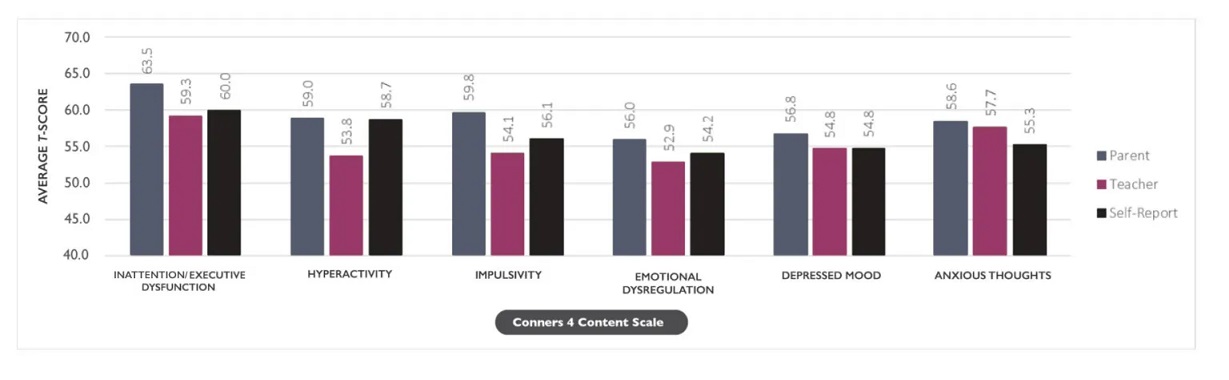
MHS reports that the fourth edition of MHS Conners offers several helpful upgrades from the previous version:
To increase cultural competency and diagnosis accuracy for BIPOC children who have previously received incorrect diagnoses, we first took into account recent studies into how ADHD manifests across cultures and ethnicities. In addition, clients can select ‘other’ as a gender rather than only ‘male’ or ‘female.’
The Conners 4 offers norm-referenced rating scales for anxiety and depression in addition to screening for potential symptoms. This allows for a more thorough understanding of a child's symptoms. Similarly, it determines the degree of a child's impairment at home, school, and in social situations rather than just asking if they struggle in various areas. It also raises further queries regarding safety and sleep-related difficulties.
Updated terminology is used in the Conners 4 to make it simpler for responders to grasp and more inclusive.
What Are The Limitations Of Conners 4?
Whether someone has ADHD or not is not determined by the Conners 4. To understand more about learning, functioning, and capacities, an assessor may conduct a cognitive evaluation.
To assess a kid or teen's capacity for prolonged attention, they could administer a sustained attention test. To determine if the kid meets the requirements for a different diagnosis in addition to or instead of ADHD, the evaluator may administer a personality test, depending on the child's age.
The Conners 4 evaluates observable behaviors, much like earlier iterations of this scale. ADHD can affect behavior since it is a neurological abnormality. Some individuals with ADHD, however, may conceal or conceal their symptoms, which might result in a false negative (test findings that are inconsistent with ADHD). To put it another way, a person with ADHD may not have an ADHD diagnosis, and their test results may not correctly represent their diagnosis.
People may still recognize signs of ADHD even if they don't manifest in a way that the Conners 4 can measure. This is true, and they can continue to use materials created by and for the ADHD community if they feel that they are helpful.
How To Complete Conners 4?
You can finish the Conners 4 online or on paper. Evaluators can give you a printed form, let you do the Conners 4 on a computer in their office, or offer you an encrypted link by email.3.
When filling out the Conners 4 parent form, which asks questions about your kid, be truthful in your responses about their conduct and what they told you.
If you, the kid or teen being examined, are filling out the self-report form, make sure to respond truthfully and understand that there are no right or wrong answers regarding your own experience.
You can choose to skip a question if you are having trouble answering it. The evaluator may not be able to rate every scale, though, if you omit a few questions. Asking the assessor questions concerning the measure or your evaluation is crucial. You can get clarification on the Conners 4 questions from the evaluator.
Bottom Line
Like many other ADHD grading scales, the Conners scale has flaws. However, when used appropriately and under a doctor's supervision, it could help parents and educators with Special education courses, better understand their child's actions and potential indicators of ADHD. The psychologist will frequently suggest retesting under their supervision, even if the individual has self-analyzed their actions before the consultation.
We believe education should be accessible for everyone. That’s why we don’t charge for our blogs. Find the right course that will help you in your career with us, contact us at 91-6292150868. You can mail us at act@asiancollegeofteachers.com
Get In Touch
UK – Registered OfficeAsian College Of Teachers Ltd (UK)
27, Old Gloucester Street, London – WC1N 3AX, UK
UK Toll Free: 0-808-189-1203
www.asiancollegeofteachers.co.uk
Disclaimer
All SEN Courses are designed, developed and created by Asian College of Teachers Ltd, United Kingdom. These courses are certified by CPD Certification Service UK and endorsed by NCC Education, UK.
Asian College of Teachers Ltd, UK has designed an extensive range of Special Education courses for teachers to equip them with the skills apt for an inclusive classroom environment. The primary objective of these courses delivered by Asian College of Teachers (ACT) is to help teachers identify the learning difficulties or disabilities and understand the specific needs of diverse pupils. These courses neither make one a SEN practitioner, nor provide with a license for clinical practice. The ACT SEN courses are certified by CPD Certification Service (UK) and endorsed by NCC Education (UK). However, these courses are not approved, endorsed or recognised by any other National / Local governmental or non-governmental agencies /bodies.
© 2026 Asian College of Teachers. All Rights Reserved. Asian College Of Teachers is a trading brand of TTA Training Pvt. Ltd (India) - CIN U80902WB2016PTC215839, Asia Teachers Training Co., Ltd (Thailand) - Registration No. 0105558193360, Asian College Of Teachers LLC, (USA) - Federal Tax Identification Number 30-1261596. Asian College Of Teachers Ltd (UK) - Company Number 9939942 & UK Register of Learning Providers (UKRLP) registration number 10098076.
Designed by kreativewebtech